Real or Artificial? What to choose & why
Thank You Hymers Farm Market for donating the 2025 CCE Christmas Tree -Why Choosing a Real Christmas Tree Matters
for Our Farms, the Environment, and Our Community
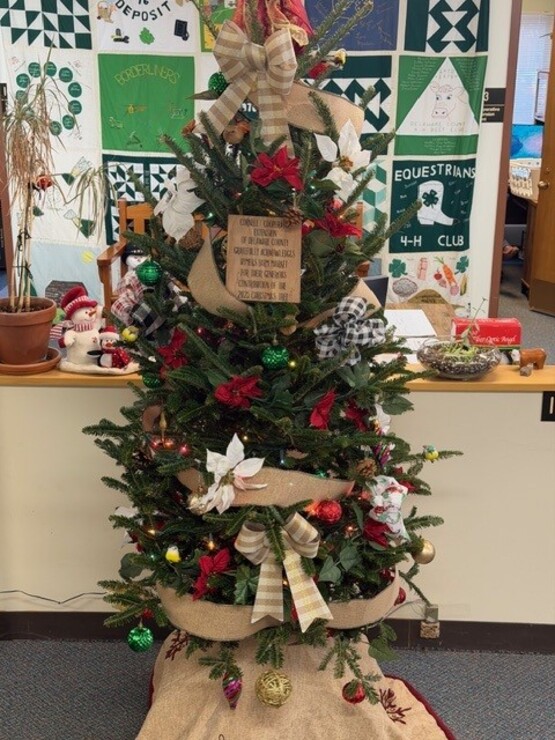
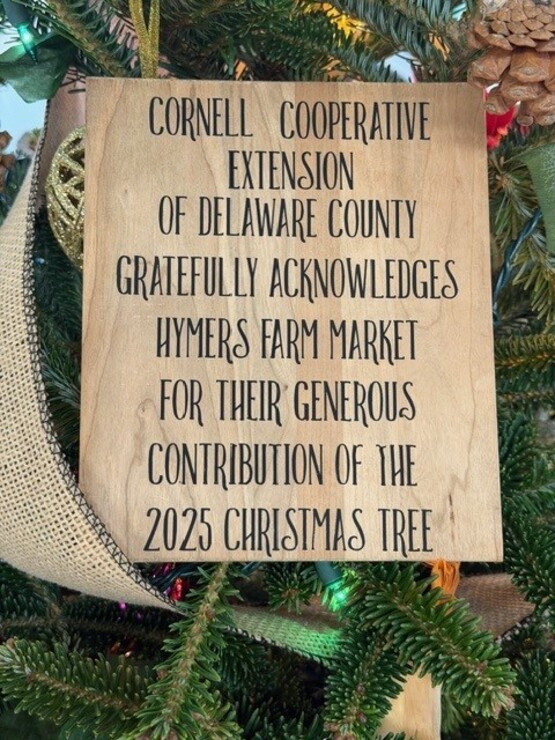
Each year, families across the country face the same holiday question: real tree or artificial? When viewed through the lens of supporting local agriculture, protecting the environment, and strengthening rural economies, real Christmas trees offer benefits that plastic trees simply can’t match.
Real Trees Support Local Farmers and Rural Economies
According to the New York State Department of Agriculture and Markets, Christmas tree production is an important agricultural sector that contributes millions to the state economy and supports family-run farms. Purchasing a real tree—especially from a nearby choose-and-cut farm or local retailer—directly supports these growers and helps keep agricultural land in production.
The American Farm Bureau Federation notes that real Christmas trees create seasonal jobs, bolster ag-based small businesses, and stimulate local spending in rural communities. These are dollars that stay local and strengthen the agricultural backbone of the region.
A Renewable, Sustainably Managed Crop
The Christmas Tree Farmers Association of New York (CTFANY) emphasizes that real trees are a renewable agricultural product. They are planted, pruned, and harvested on regular rotations, with farms replanting multiple seedlings for each tree cut. This sustainable cycle helps maintain open farmland, prevents development pressure, and ensures a continuous supply of trees for future generations.
Environmental Benefits: Carbon Sequestration and Recycling
Real Christmas trees help the environment long before they ever reach a living room. According to CTFANY, while growing, each tree absorbs carbon dioxide and releases oxygen, contributing to cleaner air and active carbon sequestration on farmland.
After the holidays, real trees can continue to benefit the environment through recycling. As highlighted in Morning Ag Clips, communities use chipped trees for mulch, soil improvement, streambank stabilization, dune restoration, and wildlife habitat projects. Because real trees are biodegradable, they return naturally to the ecosystem, unlike artificial trees that eventually enter landfills.
A Smaller Footprint Than Artificial Trees
The American Farm Bureau Federation points out that artificial trees are typically manufactured overseas from PVC plastic and metals, requiring significant fossil-fuel inputs and long-distance shipping. To match the environmental footprint of purchasing real trees annually, an artificial tree must be reused for many years.
In contrast, real trees support local agriculture, require fewer fossil-fuel inputs, and leave virtually no waste when properly recycled. A typical real Christmas tree grown on a working farm, over its lifetime, will store a measurable amount of carbon — many trees store roughly 20 pounds of CO₂ in their above-ground wood alone at harvest (and still more in their roots). When farms recycle or mulch those trees after the holidays, much of that carbon stays locked in soil. Meanwhile, artificial trees—made from petroleum-based plastics and metal—are not biodegradable and remain in landfills perpetually, contributing to long-term waste.
Tree Farms Support Wildlife and Healthy Landscapes
CTFANY also notes that Christmas tree farms are important habitats for birds and small wildlife. The spacing between trees, the groundcover maintained by farmers, and the rotation cycles all create micro-environments that support biodiversity. Many farms also practice responsible soil and water stewardship, improving the ecological value of their land.
The Added Benefit: Family Tradition and Community Connection
According to the New York State Department of Agriculture and Markets, choosing a real Christmas tree is also about tradition—visiting a farm, supporting local growers, and enjoying the sights and smells that artificial trees simply cannot offer. Many farms also sell wreaths, greenery, crafts, and locally produced goods, giving families a way to support multiple agricultural businesses at once.
The Bottom Line
Real Christmas trees:
- Support local farms and rural economies
- Provide environmental benefits while growing
- Can be recycled into beneficial materials
- Reduce waste compared with artificial trees
- Strengthen holiday traditions and community ties
Choosing a real, locally grown tree is one small decision that makes a big difference—economically, environmentally, and culturally.
Contact
Desiree Keever, JD
Ag Issue Leader
dnk2@cornell.edu
(607) 865-6531
Last updated December 11, 2025
-
Private Certified Pesticide Applicator Training
Tuesday, February 3
10:30 AM - 3:30 PM -
I Thought I Was Covered For That! Farm Insurance Webinar Series
Tuesday, February 3
12:00 PM - 1:30 PM -
NY Annie's Project: How to Diversify or Scale with Confidence for Profitability
Wednesday, February 4
11:00 AM - 2:00 PM -
Building Your Farm Future: Practical Steps for New Farmers Webinar Series
Wednesday, February 4
6:30 PM - 8:30 PM -
Cattle Confinement Fly IPM
Thursday, February 5
10:00 AM - 11:00 AM